
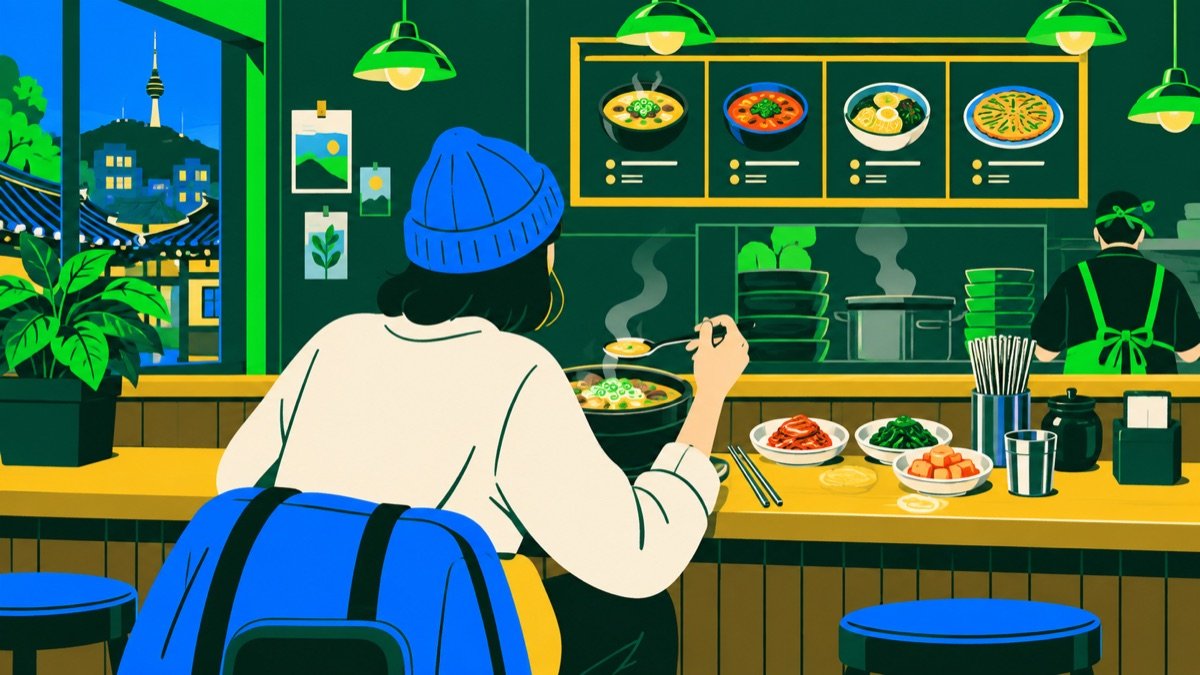
Traveling solo in Korea does not mean living on convenience-store meals. The easiest strategy is to choose restaurants built around one-person portions, then treat barbecue, hot pot, and large sharing dishes as a separate category. Some restaurants welcome solo diners; others require a minimum order or have tables designed for groups.
This guide gives you a simple way to decide before you walk in: what to search, what to order, how to ask about a minimum, and when to leave without feeling awkward.
Eating alone in Korea is possible — but the menu matters
Before entering, check these four signals:
- Look at the menu photos or listing. Single bowls, noodles, rice sets, and gimbap usually work well for one person.
- Check the Korean keywords. Search
혼밥(hon-bap, eating alone) or1인분(il-in-bun, one-person portion) in Naver Map. - Notice the table layout. Counter seats, two-person tables, and ticket machines are often easier for solo guests than large grill tables.
- Ask before sitting if the menu is unclear. A quick question saves you from ordering a dish that requires two portions.
Restaurants can change their policy by branch, time, and how busy they are. Treat a map listing as a clue, not a guarantee.
Best Korean foods for one person
Gukbap, seolleongtang, and other soups


Soup restaurants are among the easiest choices for solo travelers. A bowl usually arrives as a complete meal with rice, kimchi, and other side dishes. Gukbap means soup with rice; seolleongtang is a mild ox-bone soup; sundubu-jjigae is soft tofu stew, often served bubbling hot.
If you do not eat pork, beef, seafood, or certain broths, ask before ordering. Ingredients and stock are not always obvious from an English menu.
Gimbap and casual rice shops


Gimbap shops are designed for quick individual orders. You can order one roll, noodles, dumplings, or a rice dish without committing to a group-sized meal. They are useful on busy sightseeing days when you want something fast and easy to understand.
Bibimbap and dosirak
Bibimbap is a single-bowl meal of rice, vegetables, and toppings. A dosirak is a boxed meal with rice and side dishes. Both are straightforward first orders, but check whether meat, egg, fish sauce, or other ingredients matter for your diet.
Noodles and dumplings
Kalguksu, naengmyeon, ramyeon, and mandu are commonly ordered as individual portions. They are especially practical when you want a quick meal near a station or market.
Korean barbecue — possible, but ask first
Barbecue is the category most likely to have a minimum order. Some restaurants require two portions of meat, while others accept one diner at a counter or during a quiet period. If you are comfortable ordering two portions, say so clearly; if not, choose a restaurant that lists a one-person set.
For a complete grill-and-side-dish walkthrough, see our Korean BBQ etiquette guide.
What to say at the door
You do not need fluent Korean. These short phrases are enough:
- 혼자예요. (hon-ja-ye-yo) — “I’m alone.”
- 혼밥 가능해요? (hon-bap ga-neung-hae-yo?) — “Is eating alone possible?”
- 일인분 있어요? (il-in-bun i-sseo-yo?) — “Do you have a one-person portion?”
- 두 명분 주문해야 해요? (du myeong-bun ju-mun-hae-yo?) — “Do I need to order two portions?”
- 포장해 주세요. (po-jang-hae ju-se-yo) — “Please pack it to go.”
You can show the sentence on your phone. A polite question is better than assuming every restaurant follows the same rule.
How ordering usually works
- Wait at the entrance if there is a host or a queue. If the restaurant is self-seating, follow the signs or copy what other guests do.
- Use the ticket machine if one is available. Some machines have an English option; otherwise ask staff to help.
- Look for a call bell at the table. Many Korean restaurants use one instead of waiting for a server to pass by.
- Side dishes may be self-service. Take only what you will eat and follow the restaurant’s instructions.
- Pay at the table or counter depending on the restaurant. Tipping is not expected in ordinary Korean restaurants.
VISITKOREA explains that side dishes, water, call bells, and self-service systems vary by restaurant, so do not worry if the process looks different from home. Staff can usually show you what to do.
When to go alone
Solo dining is easiest outside the busiest meal windows. Arrive a little before lunch or dinner rush, especially at a small restaurant with limited seats. If a place is full and every table is built for groups, choose another nearby option rather than waiting under pressure.
Markets, noodle shops, soup restaurants, department-store food halls, and station dining areas are reliable starting points. For popular restaurants, check whether a reservation or waitlist is available before you travel; some services are designed for international visitors, while others may require Korean contact details.
Dietary restrictions: be specific
Do not rely only on a dish name such as “vegetable.” Broths, sauces, fish products, egg, and meat can appear in dishes that look vegetarian. Prepare a translated sentence before you go, and ask staff to confirm the ingredients.
For serious allergies, carry the Korean ingredient names in writing and keep your medication with you. Menus and recipes vary by restaurant, so a staff confirmation is more useful than a generic online label.
If the restaurant says no
Do not take it personally. The restaurant may have a two-person minimum, a busy queue, a grill designed for groups, or a menu that cannot be prepared as a single serving. Thank the staff, step outside, and choose a soup, noodle, gimbap, or food-hall option nearby.
The goal is a good meal, not winning an argument with a restaurant policy.
FAQ
Is eating alone in Korea socially unusual?
No. Solo dining is common in many everyday restaurants, cafés, soup shops, noodle shops, and quick-service places. The main exception is that some sharing dishes or busy group restaurants may set a minimum order.
Can I eat Korean BBQ alone?
Sometimes. Ask whether one person can order and whether a minimum of two portions applies. A counter seat, a one-person set, or a quieter time can make it easier.
What is the easiest first solo meal?
Try gukbap, seolleongtang, gimbap, bibimbap, noodles, dumplings, or a dosirak. These are usually served as individual portions and do not require complicated table cooking.
Do I need a Korean phone number to find a solo restaurant?
No. You can search Naver Map with 혼밥, save the Korean address, and ask at the entrance. Some reservations or waitlists may have separate phone-number requirements, so check the service before relying on it.
Should I tip?
Tipping is not expected in ordinary Korean restaurants. Follow the payment screen and local restaurant instructions instead of adding an automatic tip.
Final tip
Start with the menu, not the fear of doing something wrong. Search 혼밥, choose an individual portion, ask about the minimum, and keep a backup restaurant nearby. Once you get through the first meal, eating alone in Korea becomes one of the easiest parts of the trip.
Sources and verification
- VISITKOREA, About Korean Food and visiting Korean restaurants, checked September 28, 2026.
- VISITKOREA, CATCHTABLE Global for international visitors (KTO guide dated June 2026), checked September 28, 2026.
- LKG related guides: Korean BBQ etiquette, Best Korean Street Food, Essential Apps for Korea.
Restaurant policies, menus, reservation requirements, and ingredients vary by branch. Check the current listing and ask staff before ordering.