
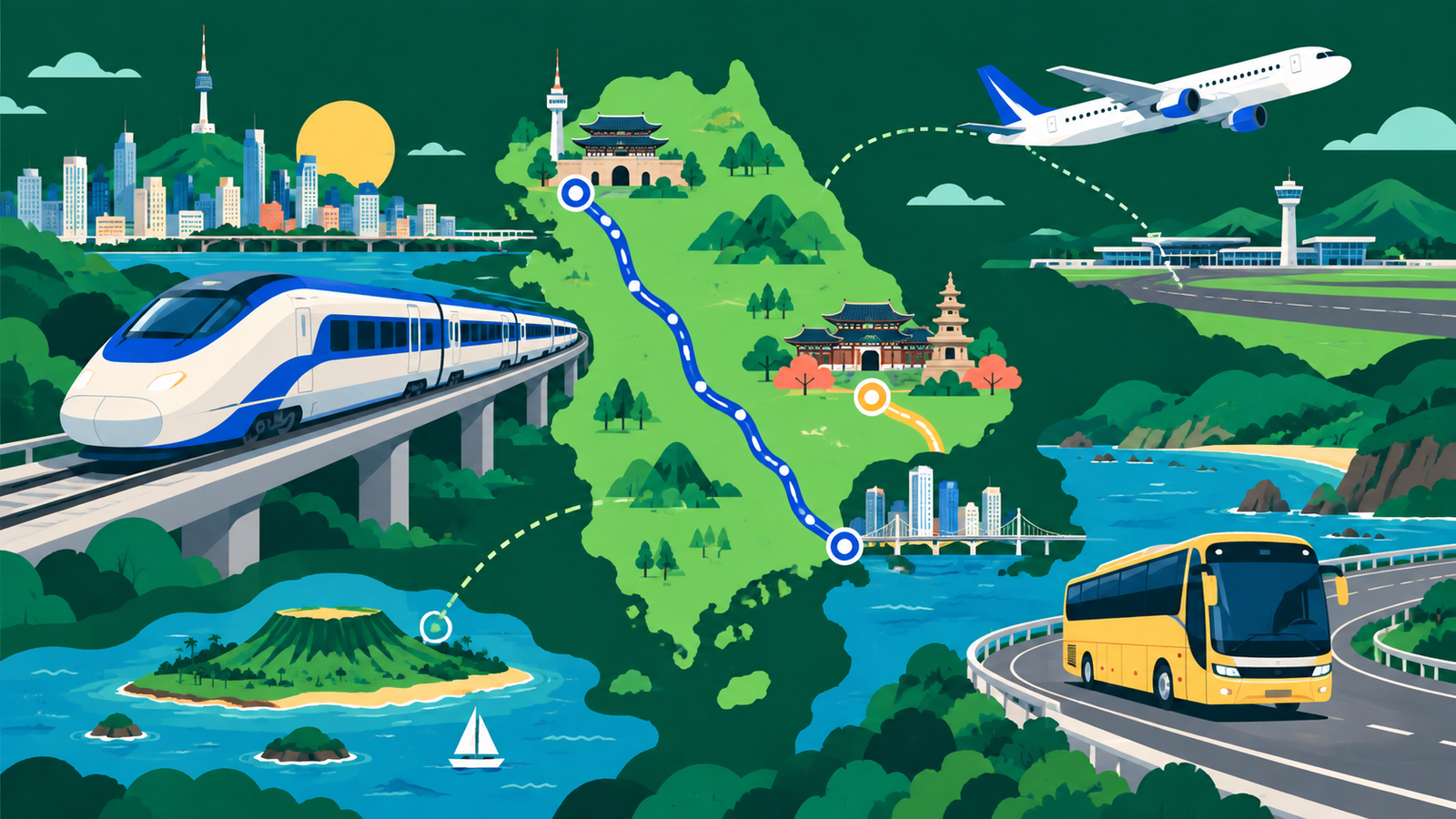
Choosing between KTX, a domestic flight, and an intercity bus in South Korea is less about finding one universal winner and more about matching the transport mode to your route. KTX is often the simplest choice between major mainland cities, flights can make sense when an airport route saves a large amount of time, and buses can be useful when the station or airport does not match your itinerary.
Always check the current schedule, fare, seat availability, luggage rules, and terminal information before booking. Transport details can change by date, operator, weather, and holiday period.
Quick answer
| Choose | When it usually fits |
|---|---|
| KTX | Seoul–Busan or another major mainland route where you want a city-centre departure and arrival. |
| Domestic flight | Jeju routes, or a journey where airport access is convenient and the flight schedule fits. |
| Intercity bus | A destination with limited rail access, or when the bus terminal is more convenient than a station or airport. |
KTX: best for major mainland city pairs
KTX is a strong default for many first-time visitors travelling between major mainland destinations. It connects city-centre stations, avoids airport check-in procedures, and makes it easier to keep the day focused on sightseeing.
Before booking, check which station you actually need. Seoul-area rail options are not interchangeable, and your accommodation may be closer to one station than another. The same applies in Busan and other cities: compare the station location with your hotel, luggage plan, and first activity of the day.
Use the official KORAIL reservation page for current routes, schedules, seat availability, and fares. Reserve earlier for weekends, public holidays, and popular travel periods.
Domestic flights: useful for Jeju and selected long routes
Flying can be practical when the route is genuinely long or when you are travelling to Jeju. It is not enough to compare the time in the air with the time on a train. Include the journey to the airport, check-in and security time, baggage collection, and the transfer from the arrival airport to your accommodation.
For international arrivals, do not assume that an Incheon connection is automatically convenient. Check the airline, terminal, connection process, and whether you need to collect or re-check baggage. Incheon Airport notes that terminal assignments can differ because of codeshares and airline circumstances, so verify the current information through your e-ticket or airline.
Check current airport and airline information through Incheon Airport’s transfer guide and its flight information page.
Intercity buses: flexible for destinations outside the rail network
Intercity and express buses can be the practical choice when your destination is not close to a KTX station or when the bus terminal is closer to your accommodation. They can also work well for shorter regional routes where changing to a train would add a transfer.
The trade-off is that road travel is more exposed to traffic. Leave extra time when travelling on Friday afternoons, weekends, holidays, or before a fixed reservation. Check the terminal name carefully: a city may have more than one bus terminal, and the most convenient terminal for arrival may not be the one closest to your departure point.
For an English overview and current booking links, use VISITKOREA’s express and intercity bus guide. It links to the official KOBUS, TXBUS, and Bustago services.
Compare the whole journey, not only the vehicle
- Door to door: How long will it take from your accommodation to the final destination?
- Luggage: Will you need to carry, store, or re-check your bags?
- Transfer risk: How many changes are required, and what happens if the first leg is delayed?
- Station or airport location: Is the arrival point close to your next activity?
- Booking flexibility: What are the change, cancellation, and refund conditions?
Route examples
Seoul to Busan
Start by comparing KTX with a flight using door-to-door time. KTX is often easier when your accommodation is near a central station and you want to arrive in the city without a second airport transfer. A flight may be worth considering when the airport route is convenient, the fare is attractive, or your schedule is built around a specific departure.
Seoul to Jeju
Compare flights by airport access, baggage rules, and arrival transfer—not only the advertised flight time. Jeju travel is especially sensitive to weather and schedule changes, so keep important reservations flexible when possible.
Seoul to Gyeongju
Compare the nearest rail station, the final local transfer, and the amount of luggage you have. A train may be efficient for the main journey, but the last connection can determine which option feels easiest.
Common mistakes to avoid
- Comparing only the time shown on a train or flight listing.
- Choosing a station or terminal without checking its location.
- Leaving no buffer before a timed tour, ferry, or flight.
- Assuming T-money or a local transit pass covers KTX or long-distance travel.
- Booking a non-refundable ticket before confirming the itinerary.
- Forgetting that airport terminal and baggage rules can change.
FAQ
Is KTX always better than a domestic flight?
No. KTX is often convenient for major mainland routes, but a flight can be a better fit for Jeju or for a route where airport access and timing work well. Compare the complete journey.
Can I use T-money for KTX?
No. T-money and local transit passes are for local transport. KTX, SRT, and intercity buses require separate booking or payment arrangements.
Should I book transport before planning hotels?
For a short trip, check transport first when your itinerary depends on a fixed train, ferry, or flight. For a flexible trip, choose your neighbourhoods first and then compare the nearest stations and terminals.
How much buffer should I leave?
Use more buffer for airports, holiday travel, tight transfers, and non-refundable reservations. Check the operator’s current guidance and allow extra time for luggage and station transfers.
Related guides
- How to Use Korea Public Transportation
- Best Areas to Stay in Seoul and Busan
- Late-Night Incheon Airport to Seoul
- Seoul, Busan, and Jeju: How Many Days?
Information checked: September 28, 2026. Train, flight, bus schedules, fares, terminals, and booking rules can change; verify the operator’s current page before you travel.