
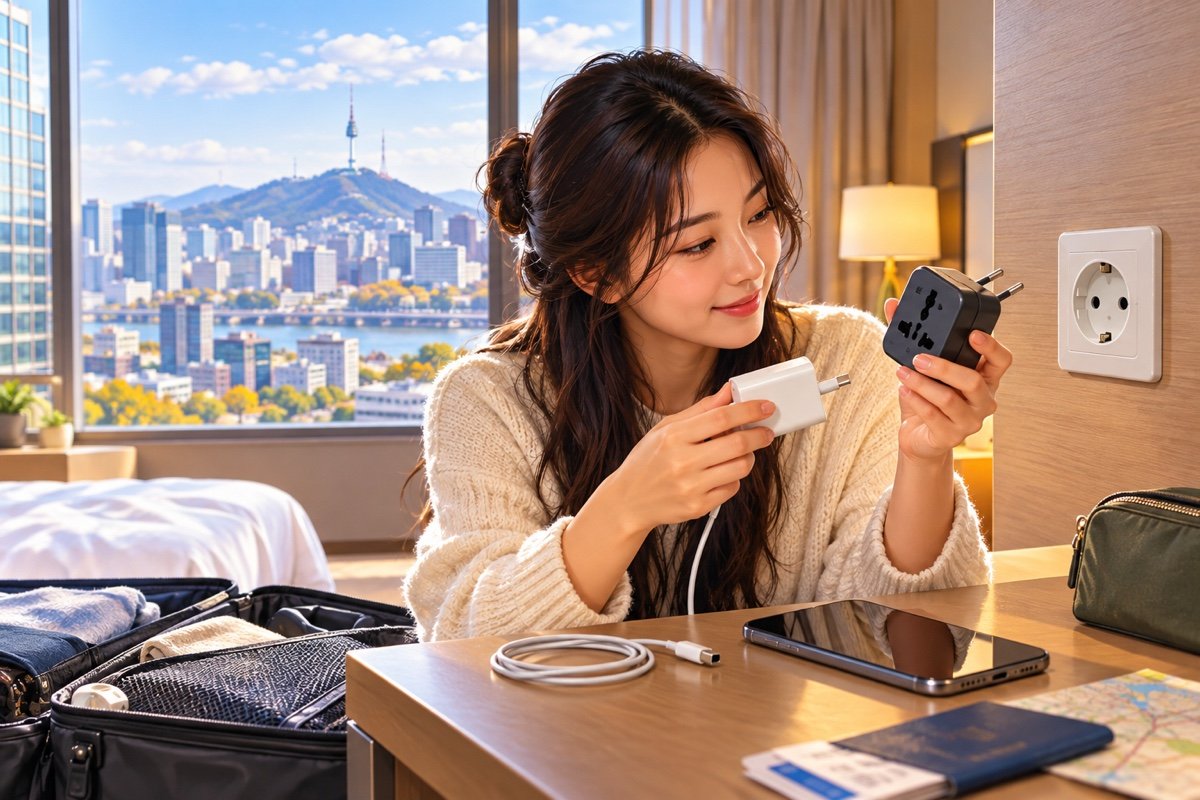
Last checked: October 4, 2026. South Korea’s standard electricity supply is 220 volts at 60 hertz, and outlets commonly use round two-pin sockets. A plug adapter and a voltage converter do different jobs: the adapter changes the shape of the plug; it does not make a 110V-only appliance safe on 220V.
Read the label on each device
Look at the charger or appliance for an input range such as “100–240V, 50/60Hz.” If the label includes Korea’s 220V/60Hz supply, you generally need only a plug adapter for the socket shape. If the device says only 100–120V, do not plug it directly into a Korean outlet; check the manufacturer’s guidance for a correctly rated voltage converter or leave it at home.
Do not rely on the charger’s USB connector or the fact that another traveler used the same model. Hair dryers, curling irons and other heating appliances deserve particular care because they draw more power. Verify the voltage and wattage requirements printed on the exact device.
What to pack
- A Type C/F-compatible adapter if your plug does not fit a Korean round-pin outlet
- A voltage converter only if your device is not rated for 220V and its manufacturer approves converter use
- A compact multi-port charger with an input label that covers 220V/60Hz, if suitable for your devices
VISITKOREA says hotel front desks may lend a universal adapter, and adapters are sold at some airport shops, but availability is not guaranteed. Ask your hotel before departure instead of planning around a loan. Our packing checklist covers other items to prepare.
Source: VISITKOREA, electricity and voltage (checked October 4, 2026). Image credits linked above; photos illustrate accommodation, not socket specifications.Quick examples
- Phone charger marked 100–240V, 50/60Hz: it is designed for a broad input range; you may still need a shape adapter.
- Appliance marked 110V only: do not connect it directly to a 220V outlet. Check the manufacturer’s approved converter and wattage requirements.
- Dual-voltage hair tool: confirm the switch or input label is set for 220V before plugging in.
Never judge compatibility by plug shape alone. A universal travel adapter may fit different sockets but usually does not convert voltage. If a converter is required, it must be rated for the appliance’s power draw; small travel converters may not support heating devices.
Useful Korean phrases: “어댑터 빌릴 수 있어요?” means “Can I borrow an adapter?” and “콘센트가 어디 있어요?” means “Where is the outlet?” A hotel may help, but availability differs by property; ask in advance.
Photographs are credited to their Unsplash contributors; use is subject to the Unsplash License. Captions identify when a photo is contextual rather than documentary.
>