
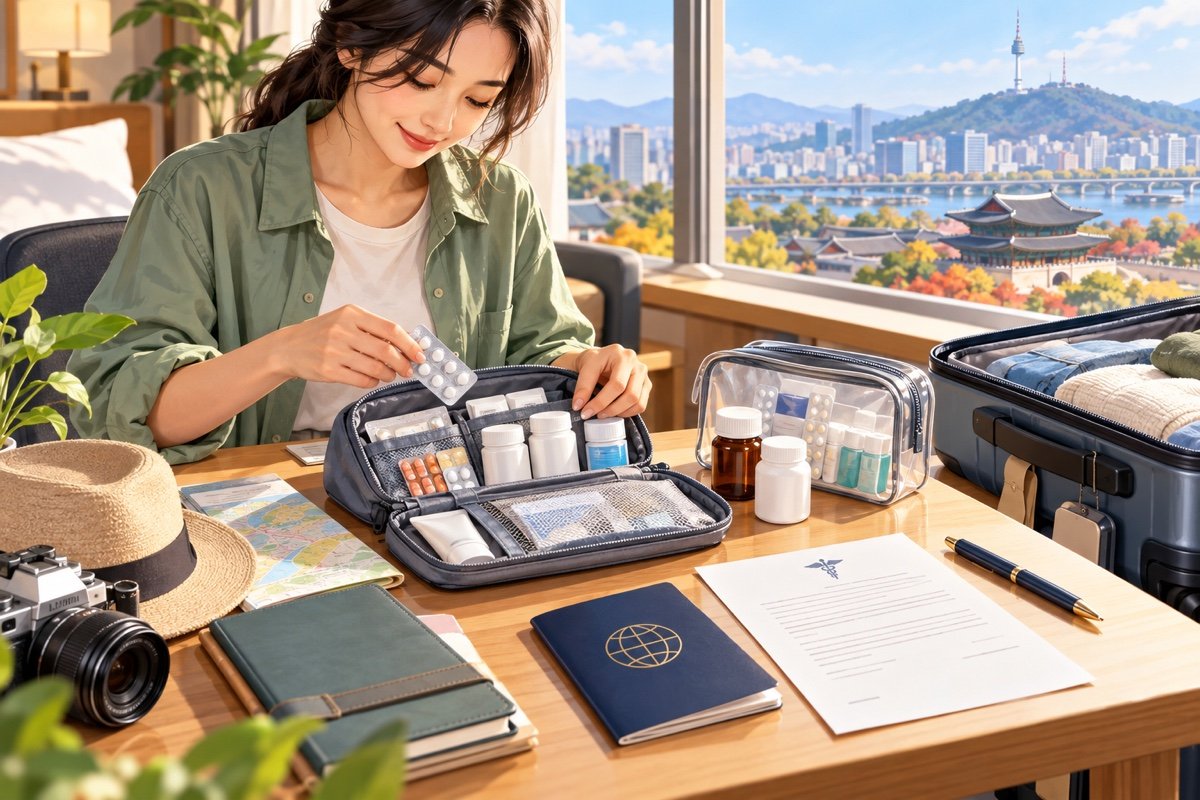
Last checked: October 4, 2026. Before packing prescription medicine for Korea, check the active ingredient—not only the brand name—and confirm the current rule with Korea’s Ministry of Food and Drug Safety (MFDS). A medicine sold legally in your home country may be controlled or restricted under a different name in Korea.
This is a travel-planning guide, not medical or legal advice. Do not stop or change a prescribed treatment based on this article. Ask your prescriber and the Korean authority about your exact medicine and itinerary.

Step 1: write down the active ingredient
Photograph or note the generic ingredient, strength, dosage form and the amount you plan to carry. Brand names can differ between countries, and a familiar name does not prove that the ingredients are identical. Keep medication in original labeled packaging when practical and carry a copy of the prescription or a clinician’s letter. These documents help explain what the medicine is, but they do not replace an import permit if one is required.
Step 2: check whether the ingredient is controlled
MFDS says a traveler entering Korea with medicine containing a controlled substance must obtain prior approval, regardless of nationality. Apply through the official MFDS process before departure and allow time for review. Do not assume a personal prescription, a small quantity or a short visit creates an exemption. The controlled-substance list and application instructions are the decisive sources for your ingredient.
Start with the MFDS English notice on bringing medicines containing controlled substances and follow the linked application route. If the English page does not clearly cover your ingredient, ask MFDS directly; do not rely on a general travel forum answer.
Step 3: separate customs rules from airport security rules
There are two different questions: may you bring the medicine into Korea, and may you carry it through airport security in your hand luggage? Incheon Airport’s cabin-liquid guidance addresses screening, not import permission. A doctor’s note or prescription may be relevant to a liquid medicine at security, but it is not a substitute for MFDS approval when the active ingredient is controlled.
Before you fly
- Check the generic ingredient against the current MFDS list.
- Apply for any required approval before travel and retain the decision.
- Keep the medicine labeled and accessible; pack a reasonable amount for the trip only after confirming the rule.
- Confirm airline and transit-country rules separately, especially if changing planes.
Make an ingredient-specific plan
Write down the generic name and strength from the package, then check it against the MFDS controlled-substance guidance. If the medicine is listed or the category is unclear, contact MFDS before travel to confirm the application form, supporting documents, permitted quantity and processing lead time. This article cannot identify a medicine by brand or decide whether a permit applies.
Keep the approved application result with your travel documents if MFDS issues one. Pack medication so customs can identify its original label; avoid moving tablets into an unmarked organizer for the international flight. Ask your airline about hand-luggage needs, and separately confirm any transit-country requirements.
For liquids, syringes or temperature-sensitive treatment, ask your clinician and airline how to carry it safely. An airport screening exception, when applicable, is not a customs authorization. Do not leave medically necessary treatment behind without discussing an alternative with the prescriber.
Photographs are credited to their Unsplash contributors; use is subject to the Unsplash License. Captions identify when a photo is contextual rather than documentary.
Sources: MFDS and Incheon Airport cabin-liquid guidance (checked October 4, 2026). For a specific medicine, obtain a direct answer from MFDS and your prescriber.