
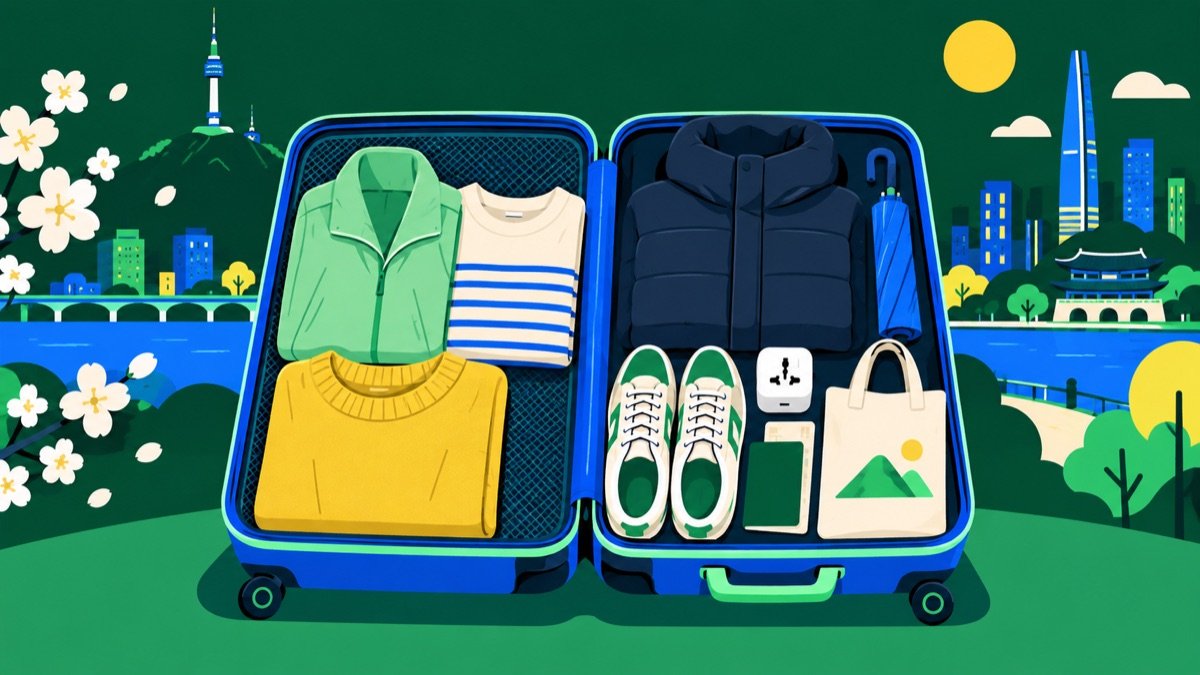
Korea is easy to explore when your suitcase matches the season. The country has four distinct seasons, but a Seoul walking day, a humid summer evening, a mountain trip, and a coastal weekend can all feel different. Pack layers and shoes you can walk in, then keep a small weather-change kit in your day bag.
- The short version
- What to pack in your personal item
- Spring: March to May
- Summer: June to August
- Fall: September to November
- Winter: December to February
- Shoes: the item people regret most
- Toiletries, medicine, and useful small items
- Electronics and the Korea plug
- Liquids, food, and airport security
- What to leave at home
- Final packing check
- Sources and verification
This list is for a first trip. It focuses on items that solve common problems without asking you to pack your whole home.
The short version
- Every trip: passport, travel documents, phone, charger, comfortable shoes, basic medicine, and a compact day bag.
- Spring and fall: light layers, a packable jacket, and a small umbrella.
- Summer: breathable clothes, sun protection, quick-dry socks, and rain protection.
- Winter: warm layers, gloves, lip balm, and shoes with good grip.
- Before departure: check your airline’s baggage rules and Incheon Airport’s current liquid and battery restrictions.
What to pack in your personal item
Keep the items you cannot afford to lose with you, not in checked luggage:
- Passport and any required entry documents.
- Phone, charging cable, and a small power bank that meets your airline’s rules.
- Accommodation address in English and Korean, saved offline.
- Prescription medicine in its original packaging, plus a copy of the prescription if useful.
- One change of clothes and basic toiletries if you check a suitcase.
- A pen, tissues, hand sanitizer, and a reusable shopping bag.
Use our first-time Korea travel checklist to handle the documents and arrival steps before you start packing.
Spring: March to May
Spring can be comfortable for walking, but mornings and evenings may feel much cooler than the afternoon. Pack a base layer, a light sweater or fleece, and a water-resistant jacket that can handle a short shower. Comfortable trainers are more useful than a new pair of dress shoes.
If you are sensitive to dust or pollen, add a few masks, eye drops, and any medication you already use. Check the forecast shortly before departure rather than relying on a single seasonal average.
Summer: June to August
Summer is warm and humid, and the rainy season can bring sudden downpours. Pack light, breathable clothes, quick-dry underwear and socks, sunscreen, a hat, and a compact umbrella. A small towel or handkerchief is genuinely useful on long subway walks and outdoor sightseeing days.
Keep electronics and your passport in a waterproof pouch inside your day bag. Do not overpack jackets: indoor air conditioning is the main reason you may want one thin layer.
For the rainy-season context and timing, compare this list with our season-by-season Korea guide.
Fall: September to November
Fall is often comfortable for walking, but temperatures can shift during the day. Pack a T-shirt or light base layer, a sweater, and a medium-weight jacket. A scarf is optional; a packable rain shell is more versatile.
This is a good season for long neighbourhood walks, so prioritize shoes with cushioning and socks that you have already tested. Leave room for a light shopping layer rather than bringing a bulky coat.
Winter: December to February
Winter can be cold and dry, with especially sharp wind in open areas. Pack thermal base layers, a warm coat, gloves, a hat or ear warmer, thick socks, and lip balm or moisturizer. Shoes should be comfortable for walking and have enough grip for wet pavement or occasional snow.
If you plan a ski resort or mountain day, add a neck warmer and waterproof outer layer. Some equipment can be rented, so confirm the rental list before filling your suitcase.
Shoes: the item people regret most
Bring one pair of comfortable walking shoes that are already broken in. Korea’s stations, markets, palaces, and hillside neighbourhoods involve more steps and stairs than a map suggests. Add a second pair only if the trip is long or you need a formal option.
Avoid packing shoes that have never been worn outside. Blisters are harder to solve on a busy sightseeing day than a missing accessory.
Toiletries, medicine, and useful small items
Bring prescription medication, contact lenses, and the products you cannot easily replace. For ordinary toiletries, pack travel sizes and buy replacements locally if needed. A small laundry bag, earplugs, tissues, and blister plasters take little space and solve common travel annoyances.
If you have allergies or dietary restrictions, save the Korean words in your phone and carry medication as directed by your clinician. Our Korean restaurant and food guides can help with everyday ordering, but restaurant ingredients still need to be confirmed on site.
Electronics and the Korea plug
Korea uses 220V electricity and two-round-pin outlets. Bring a compatible adapter, and check whether your hair dryer or other high-power device supports 220V before plugging it in. A compact multi-port charger can reduce cable clutter.
Power-bank and battery rules can change. Incheon Airport’s current guidance says spare power banks under 160Wh are carry-on items, with additional conditions for units between 100Wh and 160Wh. Check the airport and your airline again before departure; never place a loose spare battery in checked luggage unless the airline explicitly permits it.
Liquids, food, and airport security
For international departures, Incheon Airport currently allows carry-on liquids in containers of 100ml or less, placed in one transparent 1L bag per person. Gochujang, kimchi, toothpaste, sunscreen, and gel-like foods can count as liquids or gels. Duty-free liquids have separate sealed-bag requirements.
Rules at your departure airport and on connecting flights may differ. Use the Incheon Airport restricted-items guide and your airline’s current baggage page as the final check.
What to leave at home
- A full outfit for every possible weather scenario.
- Unworn shoes or heavy “just in case” gear.
- Large bottles of shampoo and body wash.
- Bulky towels and items your accommodation already provides.
- Food, plants, or medication that may require customs documentation without checking first.
Pack for your actual itinerary, not an imaginary emergency. Seoul, Busan, Jeju, and a mountain day may need different layers, but you can usually wash clothes and buy basic supplies after arrival.
Final packing check
The night before you leave, check five things: passport, phone and charger, accommodation address, medication, and weather forecast. Then weigh your bags, put liquids in an accessible place, and keep one warm or rain layer in your personal item.
Sources and verification
- Korea Meteorological Administration, Korea’s climate characteristics (Korean-language page; 1991–2020 normals), checked September 28, 2026.
- VISITKOREA, Climate, checked September 28, 2026.
- Incheon International Airport, Prohibited and restricted carry-on items, checked September 28, 2026.
Weather, airline allowances, and airport security rules can change. Check the official source again shortly before departure.